
The email arrives on a Thursday.
A funder you've been courting for a year has money to move before their fiscal year closes. They want an impact snapshot: who you served, what changed, what happened after the sessions. The deadline is ten days.
You have the data. Sort of. The counseling notes are half-entered because your coaches are three weeks behind on the CRM. The meeting transcripts live in one advisor's note-taking app and another advisor's legal pad. Referral outcomes are buried in email threads. The intake forms are in one system, the session records in another, and the connection between them is whatever your program manager can reconstruct from memory. So your team spends the next ten days doing archaeology instead of strategy, and the report you finally send tells maybe half the story your organization actually lived.
Here's a second version of the same problem. A founder reaches out on a Tuesday. She met with one of your advisors three weeks ago, can't remember the lender they mentioned, and your advisor is out this week. The notes live somewhere between that legal pad, an inbox, and your advisor's head. So she waits, and in that wait, momentum dies a little.
And a third. Your program director is designing next year's cohort right now. What are they building it on? Hunches. Anecdotes from the coaches who speak up loudest. A survey from eight months ago with a 12 percent response rate. Not because your director lacks judgment, but because nothing in your stack can actually tell them what your founders keep asking for, where they keep getting stuck, and which needs go unmet week after week. The evidence exists. It's just trapped in a hundred conversations nobody structured.
Three different pains. An operational one, a client one, a strategic one. One root cause: nobody built the layer that manages the work around the work.
The field built the stack. Nobody built the operating system.
Give the field credit: entrepreneur support has quietly assembled a real technology stack over the past two decades.
We have systems of record. Neoserra, built specifically for economic development and government-funded business support programs, tracks counseling sessions, training, and outcomes with the compliance reporting that SBA-funded programs live and die by. SourceLink Pro, developed for and by entrepreneurial support organizations, gives ESOs a CRM and decision support system with referral tracking, surveys, and impact reporting trusted by federal agencies and foundations alike. General-purpose platforms like Salesforce and HubSpot anchor plenty of accelerators and chambers.
We have ecosystem intelligence. EcoMap has built connective infrastructure at the regional level: mapping resources, powering resource hubs, and giving economic developers a way to see and coordinate their ecosystems. Firms like Next Street have spent twenty years assessing small business ecosystems in cities across the country and are now building resource navigation platforms that connect entrepreneurs to advisors, capital, and services.
And in the middle, your team has duct-taped together a layer of point solutions. Calendly for scheduling. Granola or Otter for meeting notes. Maybe a chatbot on the website. Each one is genuinely useful, and each one solves exactly its own sliver.
But none of them talk to each other. The scheduling tool doesn't know what happened in the meeting it scheduled. The note-taker doesn't know the founder's history or what your organization offers. The chatbot doesn't know your coaches' calendars or your programs' deadlines. The CRM knows only what someone manually typed into it, whenever they finally got around to typing it.
Which means the integration layer holding your entire stack together is a human being. Copying, pasting, re-entering, remembering, following up. Every manual handoff is a bottleneck waiting for a busy week to break it. That's why the funder email triggers a fire drill, why the founder waits on institutional memory, and why your director designs programs on instinct.
The tools each do their job. Nothing does the job between the jobs.
The work around the work
Look at what a single coaching relationship requires beyond the coaching itself.
Someone has to answer the founder's questions when they come in, which is rarely during business hours and rarely in the format your intake form expected. Someone has to figure out which program, event, or partner fits this founder at this moment, and confirm the thing they're recommending still exists. Someone has to get a meeting on a real calendar. Someone has to prep the advisor so the founder doesn't repeat their story for the fourth time. Someone has to capture what happened in the session. Someone has to turn "I'll connect you with our lending partner" into an introduction that actually gets sent. Someone has to remember to check back in with the founder who went quiet two weeks ago. Someone has to move all of it into the system of record. And someone has to be able to find it again when the funder email lands.
That's the work around the work. It's the connective tissue of entrepreneur support, and in most organizations it's completely unsystematized, running on the most expensive and least scalable infrastructure there is: your people's time and your people's memory.

The Kauffman Foundation has observed that the most effective ESO leaders take on the extra work of building organizational infrastructure while operating in deeply resource-constrained environments, and that the combination often feels untenable. That's a polite way of describing burnout by administration. Your best people didn't join an ESO to do data entry and calendar tetris.
The work around the work is eating the work.
In any other corner of software, we have a name for the layer that handles the routine so everything above it can focus on the meaningful. We call it an operating system.
Defining the category: the ESO Operating System
An operating system is the layer that sits between the hardware and the applications. It allocates resources, manages memory, and coordinates everything so no program runs in isolation.
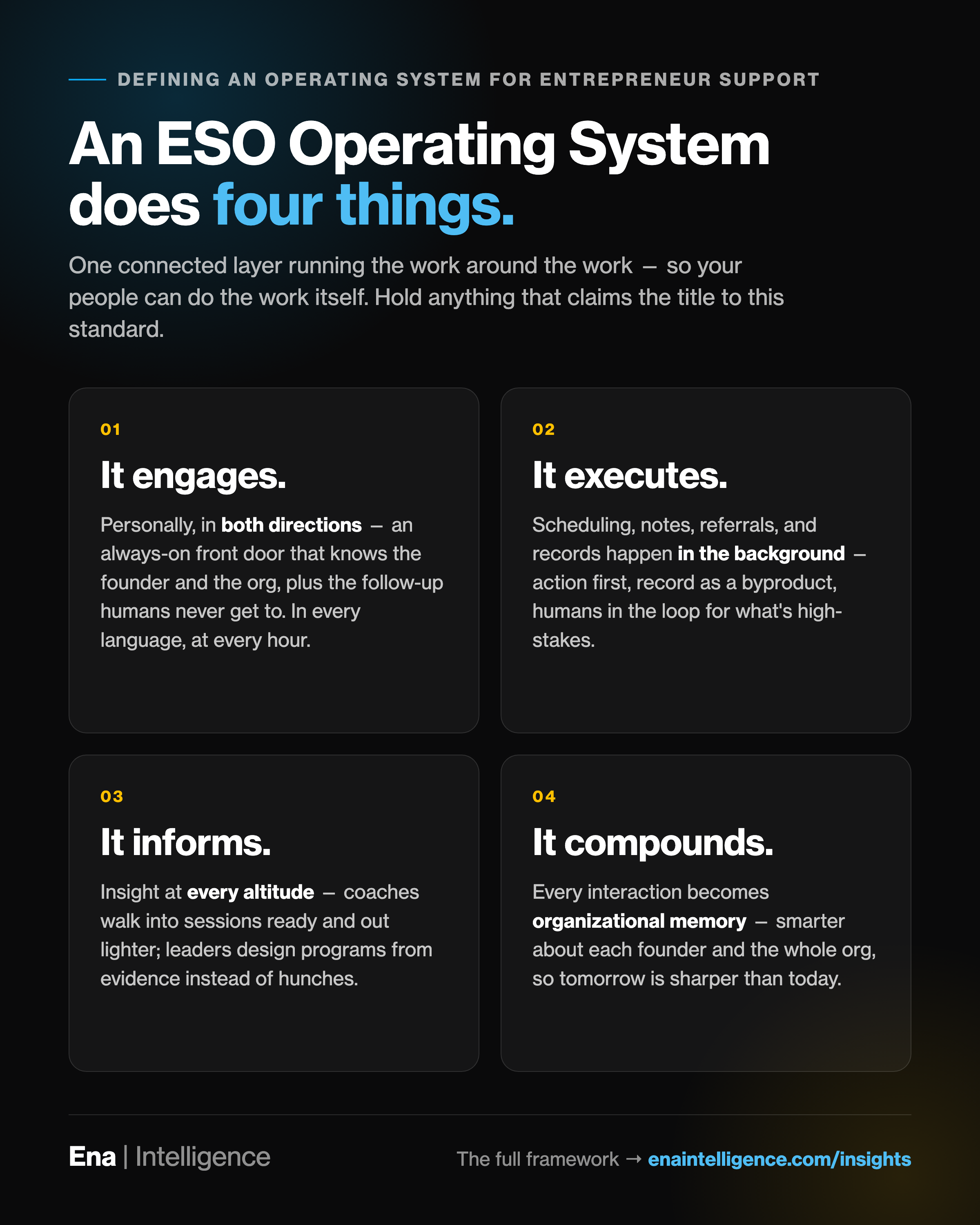
That definition implies a standard. An ESO Operating System does four things.
It engages.
Engagement runs in both directions, and it's personal in both. Inbound, the OS is an always-on front door: it answers at 11pm on a Sunday, by voice or text, in whichever of your community's languages the founder speaks, with real knowledge of two things at once. It knows your organization: programs, partners, calendars, and people. And it knows this founder: her business, her industry, her stage, her goals, her history, learned one conversation at a time the way a great advisor learns a client. Not a FAQ bot, not a ticket queue, a concierge that remembers every prior conversation, so the Tuesday founder gets her answer in the moment, because the OS knows her and the tools and relationships the organization has to help her. Outbound, it runs the follow-up humans always intend to do and rarely get to: checking in as a milestone approaches, nudging when a founder goes quiet, circling back on the loan application or the program deadline. Not a generic email blast. Outreach grounded in that founder's actual business context, at the moment it matters. In most ESOs, follow-up is the first casualty of a busy week; new clients enter the pipeline, reports come due, and the founder from three weeks ago slips quietly off everyone's list. An OS never has a busy week.
It executes.
The work around the work happens in the background, without manual entry and without anyone remembering to trigger it. The scheduling happens inside the same system that knows the founder. The meeting notes flow into the same memory that briefs the coach. The referral becomes a sent introduction, not a sticky note. Action first, record as a byproduct, zero human copy-paste in between. And for anything high-stakes, a human stays in the loop: the OS queues the action and your team approves it. This is the line between a system of record and an operating system, and equally the line between an OS and a pile of point tools.
It informs.
The OS provides insight and guidance at every altitude, from client-level support all the way to org-wide strategy. At the advisor level, it's a guide, never a replacement: it preps coaches before sessions with a sixty-second read on any client, captures what happened during them, and answers plain-language questions about any founder on the roster. The test is simple: do coaches walk into every session ready, and walk out of every session lighter? At the leadership level, it turns operations into evidence. Funder reporting stops being a ten-day archaeology dig and becomes the natural exhaust of daily work, and strategy finally rests on what founders actually ask for, where they actually stall, and which needs actually go unmet. Next year's programming gets designed from evidence instead of hunches.
It compounds, not just records.
Every conversation, session, and referral becomes structured, durable knowledge that belongs to the organization, not to whichever staff member happened to be in the room. When an advisor leaves, the relationships and context stay. And the compounding runs at two levels. The system gets smarter about each individual founder: her business, her patterns, what she's working toward, what she responds to. And it gets smarter about the organization as a whole: which programs move which kinds of founders, where cohorts stall, what the community needs next. Because every function feeds the others, richer engagement produces better execution, better execution produces deeper insight, and deeper insight makes the next engagement sharper than the last.
That fourth function is the wall between an operating system and automation, and it matters right now, because AI has made automation abundant. Every ESO is experimenting: an AI note-taker here, a chatbot there, an agent that drafts follow-up emails, a workflow that moves form data into the CRM. Each one genuinely makes a task easier. And none of it touches the three pains we started with, because disjointed AI is still a patchwork, just a smarter one. The funder email still triggers archaeology, because the AI notes live in one tool and the outcomes in another. The Tuesday founder still waits, because the chatbot answering her doesn't know her history. The director still designs on hunches, because no single tool sees the whole.
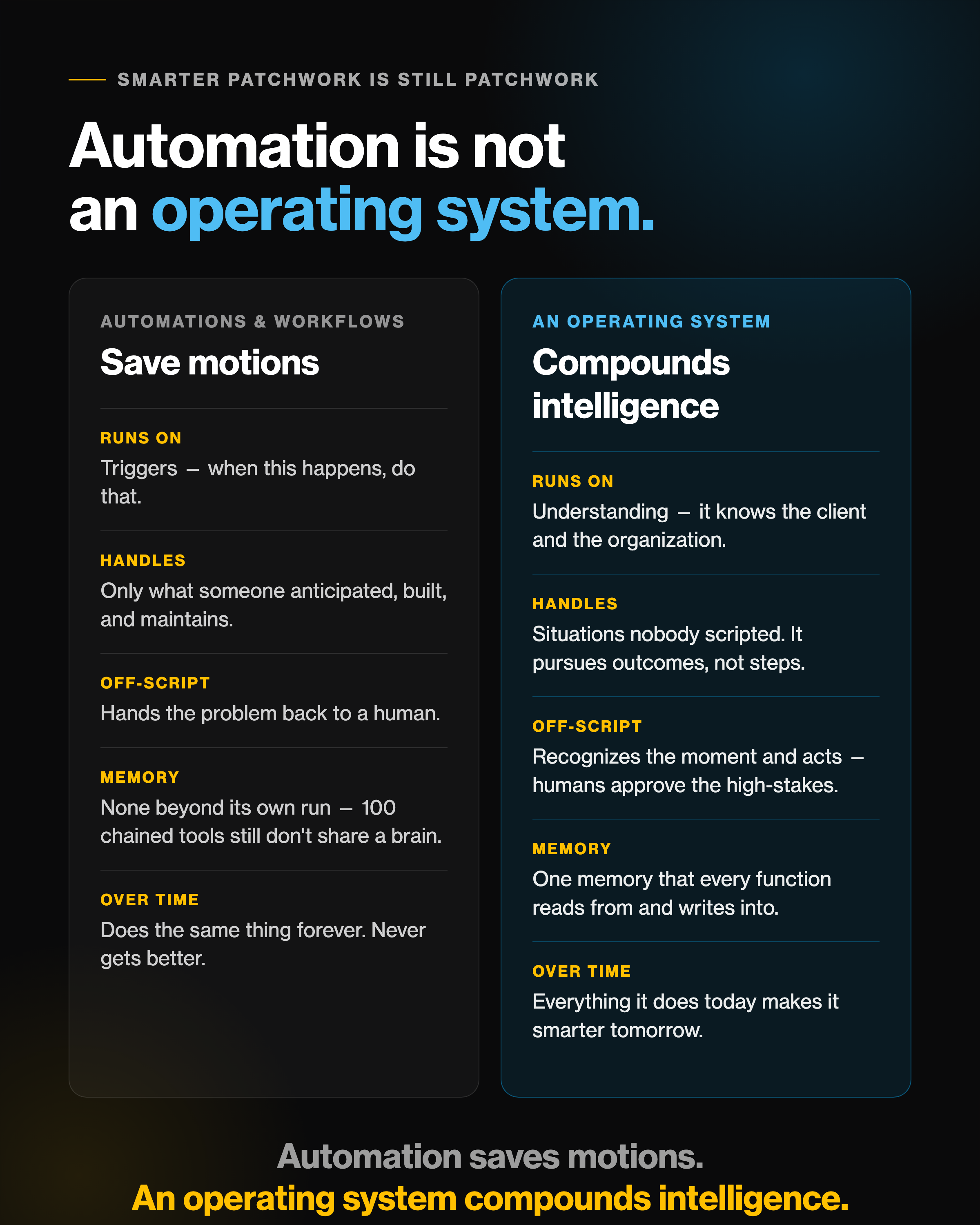
Here's why. A workflow runs on triggers: when this happens, do that. It handles exactly the situations someone anticipated, built, and now maintains, and the moment a founder brings something outside the script, it hands the problem right back to a human. An OS runs on understanding: it recognizes situations nobody scripted, because it knows the client and the organization, and it pursues outcomes, not steps. A workflow also has no memory beyond its own run. Chain a hundred automations together and they still don't share a brain, which means the human is still the integration layer, now maintaining the machines too. An OS has one memory that every function reads from and writes into. And the deepest difference is the loop. A workflow does what you told it, every time, and never gets better at it. Everything an OS does today makes it smarter tomorrow. Automation saves motions. An operating system compounds intelligence.
Notice the asymmetry in what this framework does to the existing landscape. Your systems of record stay, and get better: an operating layer feeds them clean, complete, real-time data instead of whatever staff managed to enter on Friday afternoon. The ecosystem layer benefits too: the founders arriving from your market's mapping platforms, infrastructure programs, and partner referrals now land at an organization with an always-on, data-informed support partner waiting for them, instead of an intake form and a two-week wait. The patchwork is what goes. The scheduling link, the note-taking app, the website chatbot: those aren't tools an OS integrates with. They're jobs an OS does natively, inside one system that holds the whole context. Complement the record, absorb the duct tape. That's how operating systems have always behaved, and it's the missing middle that makes the stack finally work like a stack.
Why this category is emerging now
Two forces converged.
The first is pressure. ESOs are being asked to serve more founders, in more languages, with flat or shrinking budgets, while funders raise the bar from attendance counts to outcomes and continuity. Hiring your way out of that math has never worked. Capacity has been the binding constraint on this field for as long as the field has existed.
The second is capability. Until very recently, the work around the work could not be automated without becoming inhuman, and nobody wants their founders greeted by a canned chatbot. But agentic AI crossed a threshold: it can now hold a warm, knowledgeable, multilingual conversation, take real actions like booking meetings and sending introductions, and turn every interaction into structured memory. The operating system layer wasn't skipped because nobody saw the gap. The technology to fill it humanely didn't exist.
Now it does.
Ena OS: the operating system for entrepreneur support
This is the thesis we built Ena OS on.
Ena OS is the operating system layer for entrepreneur support organizations, delivered as three connected experiences on one platform:
Client Concierge. Every founder gets an always-on assistant, by voice or chat, carrying your organization's brand, your name, your look. It answers questions from your actual knowledge base, recommends only programs and events that are active and current, books real meetings on your advisors' real calendars, helps founders apply to programs, and triggers warm introductions to partners. It speaks the founder's language, whichever one that is, at whatever hour they need it. The Tuesday founder doesn't wait for your advisor to get back.
Advisor Experience. Your coaches get an AI-powered back office: client snapshots that compress intake, history, and notes into a sixty-second read, meetings that record, transcribe, and summarize themselves, commitments that get detected in conversation and turned into queued actions, and Ask Ena, a copilot that already knows every client. The scheduling link retires, because Ena books real meetings against live calendar availability. The note-taking app retires, because meeting notes write themselves into the same memory that briefs the coach. One system, one memory, zero copy-paste.
Organizational Intelligence. Leadership sees what the organization actually knows: engagement patterns, top founder needs, referral flows, program funnels. And leadership can interrogate that knowledge directly. Ask Ena takes questions at any altitude, from "where does this founder stand with her loan application" to "what did this cohort struggle with most" to "which unmet needs should shape next year's programming," and answers with rationale and supporting evidence pulled straight from client data, not opinion. When the funder email lands, the impact snapshot is a query, not a fire drill. When your director designs next year's programming, they design it from the documented pain points of your actual clients. All of it syncs into the systems of record you already run, whether that's Salesforce, HubSpot, Neoserra, or SourceLink, and rolls up into funder-ready evidence.
Three experiences, one continuous intelligence system. Community referrals, ecosystem maps, and programming flow in. Founders get guided, advisors get amplified, and clean data flows out to your CRM and your funders. The stack finally behaves like a stack.

The layer was always missing. It doesn't have to stay that way.
Category shifts in software follow a pattern. First the tools arrive, scattered and specialized. Then someone builds the layer that makes them coherent, and afterward nobody can imagine the work without it. Sales had records before it had revenue operations. Software teams had scripts before they had DevOps. Entrepreneur support has reached the same inflection point.
So here's the claim, stated plainly: entrepreneur support organizations need an operating system, the category now exists, and every ESO leader should hold it to the standard. It engages: personally, in both directions, in every language, at every hour. It executes: in the background, with humans in the loop for what's high-stakes. It informs: at every altitude, from one founder's next step to the whole organization's strategy. It compounds: getting smarter with every interaction it captures.
Ask those four questions of anything that claims the title, including ours.
We built Ena OS because we spent fifteen years inside this field, watching brilliant, mission-driven people drown in the work around the work. If you lead an ESO and that Thursday email described your last quarter, we'd welcome the chance to show you what the operating system layer looks like running under your brand. And if you just take the framework and use it to push the whole field forward, that's a win too.
The founders are asking. The funders are watching. The layer that answers is finally here.